

Bryn Jones may be the most prolific dead man around. The strikingly consistent rate of his releases since the turn of the millennium is made all the more peculiar given he died 25 years ago, to a rare fungal infection. If the cause of death appears unconventional, it very much befits the unconventional life the Mancunian led.
Born in Salford in 1961, Bryn Jones first began releasing music as early as 1982, under the moniker E.G. Oblique Graph. As is often the case with bedroom producers who embrace a D-I-Y ethos, Jones was reclusive and secretive. His first documented live performance supposedly left him traumatised to the point where it took 9 years for him to try it again. There is a tendency for these kinds of enigmatic figures to garner a cult of personality – a mythology around them, fans bubbling with excitement at unlocking each new piece of lore. The reality may find many of these personalities to have been far less singular and notable than imagined.
The Muslimgauze project began in 1983, the alias deriving from a somewhat inelegant pun on the fabric ‘Muslin-gauze’. It hints at his central fascination: the oppression of people in Islamic countries. Fascination can become fetishisation, especially for a white Englishman who was neither Muslim nor ever visited the Middle-East. The absence of lyrics in his music might have made his messages oblique were it not for his inherently political branding. Song titles like ‘Vote Hezbollah’ and ‘All the Stolen Land of Palestine’, along with album art depicting bandaged Palestinian children and veiled women wielding guns, make it nearly impossible to separate his abstract music from his explicit political beliefs.
Yet because his music is largely instrumental, it does make for a highly subjective listening experience. Jones himself seemed to reinforce this subjectivity, having stated that “Muslimgauze have very strong political beliefs, but you can listen to a track without having opinions pushed down your throat.” He was especially conscious to ensure his music did not become “preaching”. Whilst risking a descent into the wearisome debate around the ethics of separating the art from the artist, understanding the music of Muslimgauze might mean ignoring Bryn Jones.
In large part, Muslimgauze’s music is defined by difficulty. The sheer volume of his discography prevents an easy digestion of his style, but a closer examination of one of his most critically acclaimed projects, Mullah Said, may provide a window into this enigma.
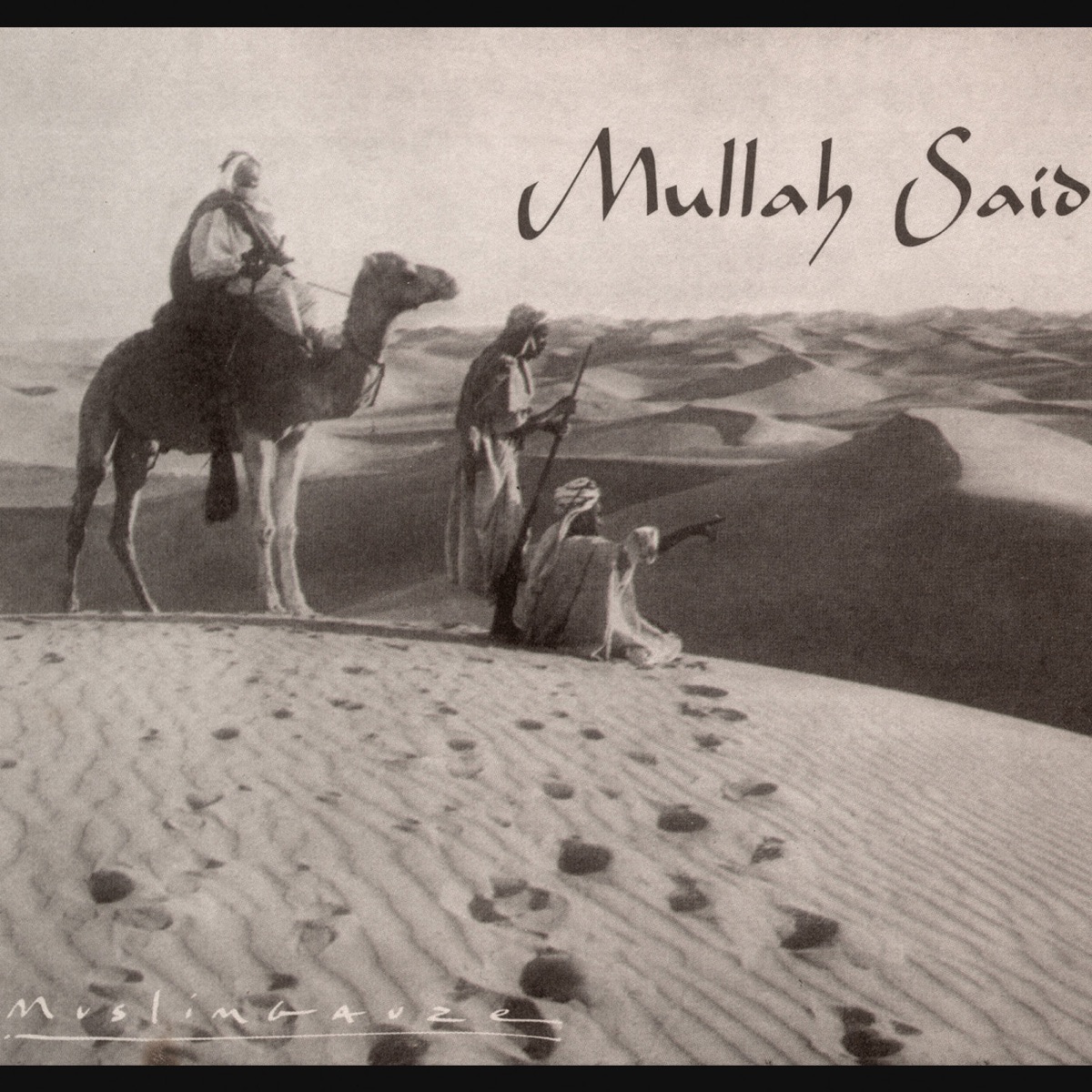
The titular opener sets the tone. A repetitive dub bass beat serves as a metronome, its foregrounded simplicity belying the ever-shifting soundscape of background vocal samples and hand percussion. The synths tie everything together – ominous and gloomy but subtle in the mix so that they hover and roam without overpowering nor underwhelming. Fleeting moments where percussion fades bring them out in all their richness.
‘Every Grain Of Palestinian Sand’ pulses with a faster tempo – the throbbing beat could almost lead into a dance track, but maintains a patient repetition that never shifts, once again acting as a metronome. The hypnotic strings take the spotlight here, whilst vocal samples of prayer, song and chatter appear abruptly only to fade just as quickly.
The formula remains similar in ‘Muslims Die India’, but whilst the first two songs feel like an experiment in creating atmosphere, this is the first track that actually feels like a lamentation. A repeated croaky inhale – the sound of wailing – cuts off sharply, unsettling in its abruptness. It returns repeatedly, revealing more of the sorrowful female voice that has almost become a stereotype in itself: the cry of a woman grieving in Arabic, a painful sound so often heard in news reports that it has desensitised many listeners. The universal emotion behind the noise might illicit concern from many, but for Westerners, the unfamiliarity of the language provides a safe distance, often rendering that concern only momentary. For many, these cries may be subconsciously associated more with distant news reports than with real-life current events. Muslimgauze either demands a deeper engagement, pulling the listener into the sorrow it conveys, or, through the sharp cut-offs, pointedly mirrors and critiques the Western tendency for fleeting attention.
Alternate mixes of the previous two tracks offer more of the same. ‘Muslims Die India (2)’ fades into an eerie emptiness, before the beat unexpectedly resurfaces. Some of these experiments can feel half-formed, but the general formula and instrumentation remains strikingly coherent.
That is until the final song: ‘An End’. The album’s first sub-ten-minute track, the two-minute closer features an intimate feminine voice singing, juxtaposed with rat-like screeches, insistent hand percussion, and the occasional deep rumble of a masculine voice buried in the mix. It makes for perhaps the most interesting song on an interesting project. Yet there remains a level of discomfort with it all.
When ignoring Bryn Jones, there is value to be found in much of Muslimgauze’s music, but ignoring Bryn Jones becomes difficult when many of his inclinations become apparent within his discography. Whilst Mullah Said is experimental and distinctive, its technological innovation is used in most part to perpetuate a stereotypical Western perspective: A war-torn eastern land, laden with male chanting and wailing women. In dubious attempts to recreate the ambiance of war, Muslimgauze ends up glamorising it.
Jones once claimed “To have been in a place is not important. So you can’t be against apartheid unless you have been in South Africa?” But the issue with Jones is not his Englishness or his decision to address oppression abroad, but rather his tendency to simplify these struggles in a way that aligns with orientalist tropes.
Whilst his unwavering focus on the subject speaks to a degree of sincerity, it’s the manner of his approach that draws questioning. He was clearly obsessed with the oppression of Muslims, but his understanding of the Middle-East was ignorant and reductive. The notion of Islam as inherently despotic is itself an age-old orientalist construct, yet Jones’ evident admiration for the likes of Qaddafi, Hussein and Khomeini (the latter of which features heavily in his album art) does little to challenge this stereotype. By elevating such figures, he actually reinforces it.
Parts of the world will certainly be more sympathetic to an earnest exploration of his music and character than others. Many have cited Jones as more anti-Zionist than pro-Palestinian, and while many may see those terms as interchangeable, it doesn’t entirely matter – his uncompromising repudiation of Israeli humanity was so blunt and forceful that it overshadowed any real engagement with the beauty, complexity and diversity of actual Islamic life.
Jones sent thousands of tapes to record labels during his lifetime, and perhaps its unsurprising his music is still being released, and still has an audience today. His politics feel almost more suited to our present era than his own – where brash, oversimplified headlines flourish in a climate of populism and overnight activism, where loudness is equated with wisdom. When Iran fired missiles at Israel, many people cheered for the same government that, just two years prior, had opened fire on peaceful protesters following the brutal, misogynistic killing of Mahsa Amini. In Muslimgauze’s work, the imagined soundscapes of Middle-Eastern conflicts merge into a single, monolithic struggle, casting one side as evil and the other as righteous. Such a message denies the real life struggles of ordinary Middle-Eastern people who do not wake up deciding to be activists or revolutionaries, but whose lives are tragically dictated by violent politics.
You can donate to support critical medical aid for Palestinians and Lebanese here.
Written by Ben Ramezani, originally published in ‘The Mancunion’, 4th December 2024, adapted for Disorientalise, 8th December 2024.
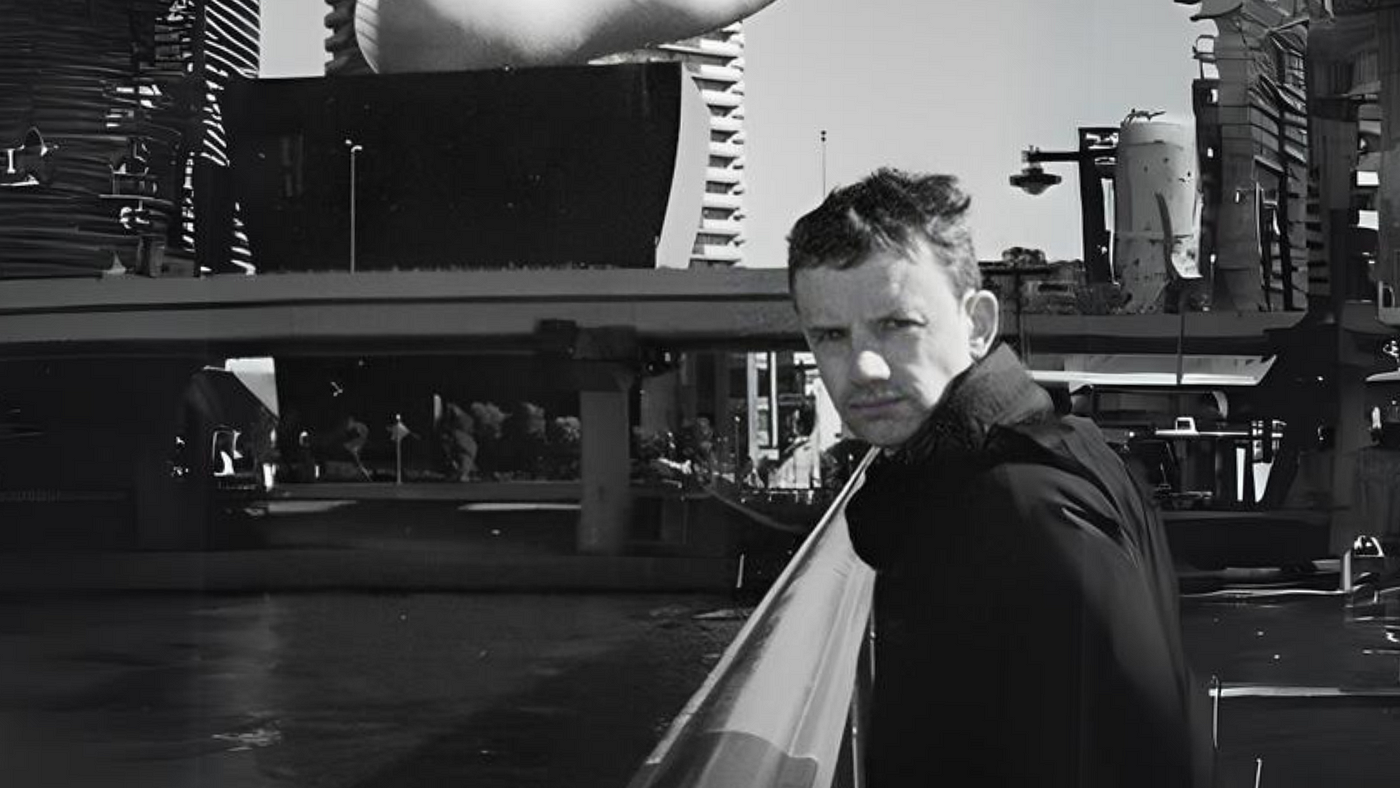
Featured Image: Muslimgauze in 1988. Credit: The Wire, Issue 365 (2014)


Leave a Reply